


Demre, Myra and St Nicholas: The Story Behind Santa Claus
 AI-generated illustrative image.
If you’ve ever wondered why Türkiye is mentioned in the story of Santa Claus, the answer is Demre on the Mediterranean coast. This small town was historically known as Myra, and it is strongly associated with St Nicholas, the Christian bishop whose reputation for generosity helped inspire centuries of winter gift‑giving traditions. Today, visitors come to Demre to see the Church of St Nicholas and to explore Ancient Myra, including its striking Lycian rock tombs and the Roman-era theatre.
Demre, Myra and the “Santa Claus Turkey” connection
When people search for Santa Claus Turkey or the birthplace of Santa Claus, they are usually trying to understand the link between the modern festive character and the historical St Nicholas. While Santa Claus as we know him is a much later cultural creation, St Nicholas of Myra is a key starting point in the long story. In Demre (ancient Myra), you are visiting a place that many Christian traditions connect directly with his life and legacy.
For travellers, Demre is also appealing for a simpler reason: you can combine a meaningful religious and cultural visit to St Nicholas Church in Demre with a very visual ancient site at nearby Myra.
Who was St Nicholas of Myra?
St Nicholas is widely remembered in Christian tradition as a bishop of Myra in the region historically known as Lycia (in modern-day Antalya Province). Accounts of his life were written and re-told over many generations, so details can vary, but the central themes are consistent: he became known for charity, protection of the vulnerable and quiet acts of generosity.
Those stories mattered because they travelled. Seafarers, merchants and pilgrims helped spread devotion to St Nicholas far beyond the south-west Anatolian coast. Over time, local customs in different countries attached gift-giving, children’s traditions and winter celebrations to his name.
Why St Nicholas is important for Christian visitors to Türkiye
Demre is not only a scenic stop on the Mediterranean; it is part of a wider map of early Christianity in Anatolia. For many visitors, the significance lies in standing in a place connected with a figure venerated across different Christian denominations, and seeing how faith, history and local heritage overlap in one location.
 AI-generated illustrative image.
From St Nicholas to Santa Claus: how the legend changed
The modern Santa Claus is the result of a long cultural journey rather than a single “origin moment”. In parts of Europe, St Nicholas became associated with seasonal gift-giving and children’s celebrations. In some places his name evolved linguistically, and his image shifted with local folklore and later popular culture.
By the time the Santa figure became widely recognised in the modern era, many elements had been added: a new style of clothing, a different personality, and a broader festive setting. Yet the core idea that a kind figure brings gifts in a winter season still echoes the older reputation of St Nicholas. That is why searches for St Nicholas Turkey and Santa Claus history so often lead back to Demre and Myra.
St Nicholas Church in Demre: what you can realistically expect
The Church of St Nicholas in Demre is the centrepiece for travellers interested in the story behind Santa Claus. It is a historic church building visited by tourists, pilgrims and those curious about Christian heritage in Türkiye.
Inside, visitors typically focus on the atmosphere and surviving architectural and decorative elements. What you see on the day can depend on conservation work and access arrangements, so it’s best to keep expectations flexible and treat the visit as a heritage site rather than an active museum-style exhibition.
Simple etiquette for visiting the church
- Dress respectfully, as you would for any religious heritage site.
- Keep voices low, especially if others are visiting for personal religious reasons.
- Ask before photographing people, and follow any on-site rules about flash or restricted areas.
As with many historic sites in Türkiye, practical details such as ticketing, opening times and temporary closures can change. Check the latest official information close to your travel date.
Ancient Myra (Myra Turkey): rock tombs and the Roman theatre
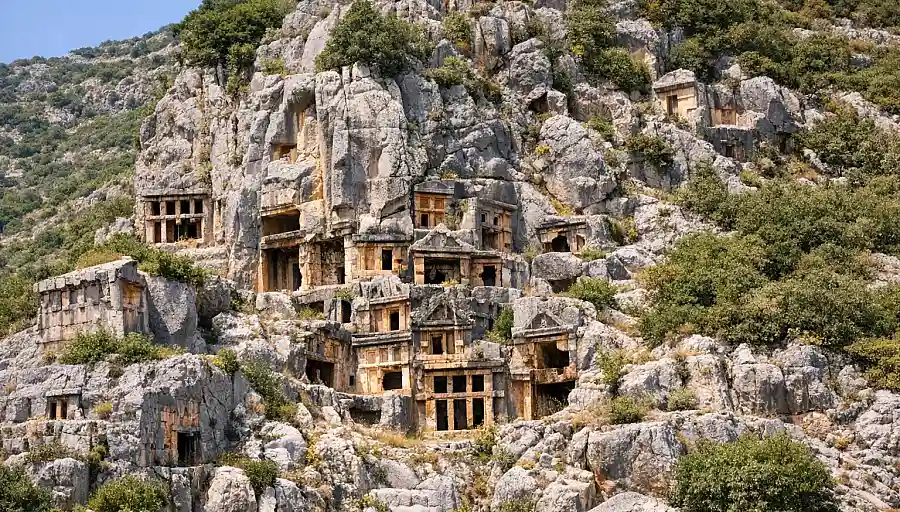
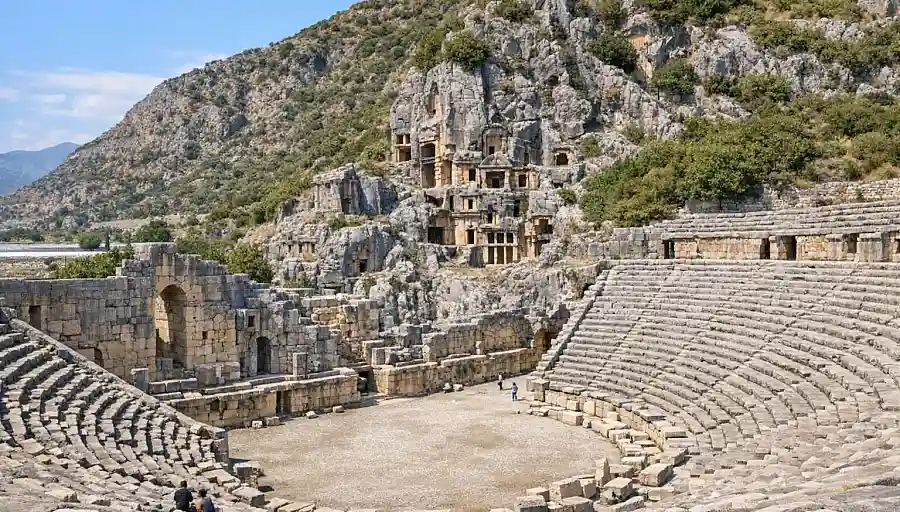
A visit to Demre is often paired with Ancient Myra, known for its dramatic Lycian rock-cut tombs carved into the cliff face and a large Roman-era theatre. Even if you arrive primarily for the St Nicholas story, Myra is usually the place that makes the strongest visual impression.
The Lycian rock tombs
The tombs are a signature of ancient Lycia. Carved high into the rock, they create a striking “city of the dead” effect. For travellers, the key thing to know is that the tombs are best appreciated slowly: step back to take in the overall cliff, then look closer at the carved façades and the way they were positioned in the landscape.
The theatre at Myra
The theatre reflects the Roman influence on the region and helps you imagine Myra as a lively ancient city rather than a single monument. Conditions on stone steps can be uneven, so sturdy footwear makes the visit more comfortable.
 AI-generated illustrative image.
How to plan a visit to Demre and Myra
Demre sits on a popular touring route along Türkiye’s Mediterranean coast, and it can work as a dedicated stop or as part of a wider itinerary. Many visitors combine Demre and Myra on the same day because the sites are closely linked in theme and location.
What to bring
- Comfortable walking shoes for uneven stone paths and steps at Ancient Myra.
- Sun protection for much of the year (hat, sunscreen, water), especially if you plan to spend time outdoors at the tombs and theatre.
- A light layer if you are visiting in cooler months, as the coast can feel breezy.
If you want the story, consider a guided visit
The link between Demre Turkey, St Nicholas and the later Santa Claus tradition is richer with context. If you enjoy historical storytelling, a licensed guide can help connect the church visit with the wider history of Myra and Lycia, without reducing the place to a novelty “Santa stop”. TurPolia can assist with arranging private guiding and day-trip logistics in the region if you prefer a structured visit.
Common misunderstandings visitors have
- Expecting a “Santa theme park”: Demre’s appeal is heritage and history, not a modern Christmas attraction.
- Assuming every detail of St Nicholas’ life is documented: many stories are based on long-standing tradition and later writings rather than a single contemporary biography.
- Skipping Ancient Myra: even if you are focused on St Nicholas, the tombs and theatre give essential context for what Myra was as a city.
Why Demre is worth visiting even if you’re not religious
Demre and Myra work on several levels: a beautiful ancient setting, a famous name with global cultural impact, and a quieter corner of the Mediterranean that feels different from larger resort centres. If you’re interested in how stories travel and change across centuries, this is one of the most tangible places in Türkiye to explore that idea.
Approach it as a meeting point of Ancient Myra, early Christian heritage and the long evolution of a winter legend that the world later turned into Santa Claus.
Frequently Asked Questions
Is Demre really the birthplace of Santa Claus?
Demre is strongly associated with St Nicholas, a Christian bishop of ancient Myra whose reputation for generosity helped inspire later gift‑giving traditions. The modern Santa Claus character developed much later through European and then global popular culture, so “birthplace of Santa Claus” is best understood as a heritage link rather than a literal origin of the modern figure.
Who was St Nicholas in Türkiye?
St Nicholas is traditionally remembered as a bishop of Myra in Lycia, in what is now south-west Türkiye. He became widely venerated for charity and protection of those in need, and devotion to him spread far beyond the region over many centuries.
What can you see at St Nicholas Church in Demre?
Visitors go to the historic church associated with St Nicholas and view the building as a cultural and religious heritage site. What is accessible can vary due to conservation and site management, so it’s worth checking the latest local information close to your visit.
What is Ancient Myra famous for?
Ancient Myra is best known for its Lycian rock-cut tombs carved into the cliffs and a large Roman-era theatre. Together they give a strong sense of Myra’s importance as an ancient city in Lycia.
Can you visit Demre and Myra as a day trip?
Yes, many travellers visit Demre and Ancient Myra in one day because they are closely linked and near each other. The best plan depends on where you are staying on the Mediterranean coast and how much time you want at each site.
TurPolia Blog
Travel stories and local tips for discovering Türkiye.


