


Ephesus Ancient City in Turkey: Foundation Story, History and What to See

Ephesus Ancient City (Ephesus Turkey) is one of the most rewarding places to explore if you want a clear, walkable introduction to the ancient world. You can follow marble streets past grand civic buildings, elegant houses and a vast theatre, while also understanding why this city became so influential in Greek, Roman and Byzantine times. For most travellers, Ephesus is an easy day trip from Selçuk, İzmir or Kuşadası—and it is well worth planning properly, because the site is large, open and full of details that are easy to miss without context.
Where Ephesus is located (and why the location mattered)
Ephesus sits near the modern town of Selçuk in Türkiye’s İzmir region, not far from the Aegean coast and the holiday hub of Kuşadası. In antiquity, this area was valued for two linked reasons: it was positioned on busy trade routes, and it was also a major religious centre. Ephesus was connected to the sea via its harbour and waterways, which supported commerce and made it a natural meeting point for merchants, officials, sailors and pilgrims.
That combination—trade and religion—helped Ephesus grow beyond a normal city. It became a place where wealth, politics, architecture and belief all shaped the streets you walk today. When you visit the Ephesus ruins, you are not only seeing impressive buildings; you are seeing the footprint of a city that once mattered on an international scale.
The foundation story: how Ephesus began
Like many ancient cities in the Aegean world, the foundation of Ephesus is described through a mix of legend and long-term settlement. Ancient sources link the city’s beginnings to early Greek settlers in Ionia, while archaeology also points to communities living in the wider area before Ephesus became the major city we recognise today.
What matters for travellers is not just a single “founding moment”, but the pattern: Ephesus grew where people could control movement between the coast and inland routes, and where religious identity could draw visitors. The cult of Artemis became central to the city’s status, and the sanctuary associated with her helped define Ephesus as more than a trading town. Over time, Ephesus developed into one of the headline ancient cities in Turkey—large, wealthy and influential enough to be remodelled and rebuilt across different empires.
The history of Ephesus in three major eras
Greek and Hellenistic Ephesus: a city shaped by the Aegean
Ephesus is often described as a Greek city in both language and culture, and its early development is tied to the wider Greek world of the Aegean. Across the centuries, the city also passed through periods of control and influence from larger regional powers. Later, during the Hellenistic era, Ephesus was significantly re-planned and expanded, reflecting the tastes and city-building ambitions of the time.
For visitors today, the key point is that Ephesus did not grow randomly. The streets, the public spaces and the monumental approach to architecture reflect a city with resources—and with leaders willing to invest in a built environment that projected prestige.
Roman Ephesus: peak wealth, monumental building and daily life
For most people, the most recognisable ruins belong to the Roman-era city. Under Roman rule, Ephesus became a major urban centre in the region, attracting investment, administrators and visitors. The city’s public buildings—baths, temples, fountains, squares and libraries—were not only practical; they were designed to show status and civic pride.
This is the period that gave Ephesus some of its most famous landmarks, including the Library of Celsus and the Great Theatre of Ephesus. It is also the era that makes Ephesus such a satisfying site for travellers: you can still read the city as a functioning place, with routes for processions, shopping streets, political gathering points and residential areas that reveal the gap between elite living and everyday life.
Byzantine Ephesus: a Christian centre and a changing city
In late antiquity and the Byzantine period, Ephesus became closely connected with early Christianity. Important church structures and traditions are linked to the area, and the city remained significant even as patterns of trade and population shifted. Over the long term, a combination of changes—economic, environmental and political—contributed to Ephesus losing the position it once held in the Roman period.
When you visit, it helps to remember that Ephesus is not a “single-time” ruin. The site is the result of centuries of rebuilding, repurposing and adaptation. That layered history is one reason an Ephesus guided tour can add real value: it is easy to admire the stonework, but much harder to understand what belongs to which era without explanation.
Things to see in Ephesus: the landmarks that bring the city to life
Ephesus is best enjoyed as a sequence of places rather than a checklist. As you walk, you move between civic power, religion, entertainment and domestic life—exactly the mix you would expect in a major ancient city. These are the highlights most travellers prioritise on an Ephesus day trip.
Library of Celsus
The Library of Celsus is the image most associated with Ephesus—and in person it is as dramatic as you expect. Its ornate façade makes a strong statement about education, prestige and urban identity in the Roman city. Spend a few minutes stepping back to take in the proportions, then move closer to notice the decorative details and the way the building frames the space around it.
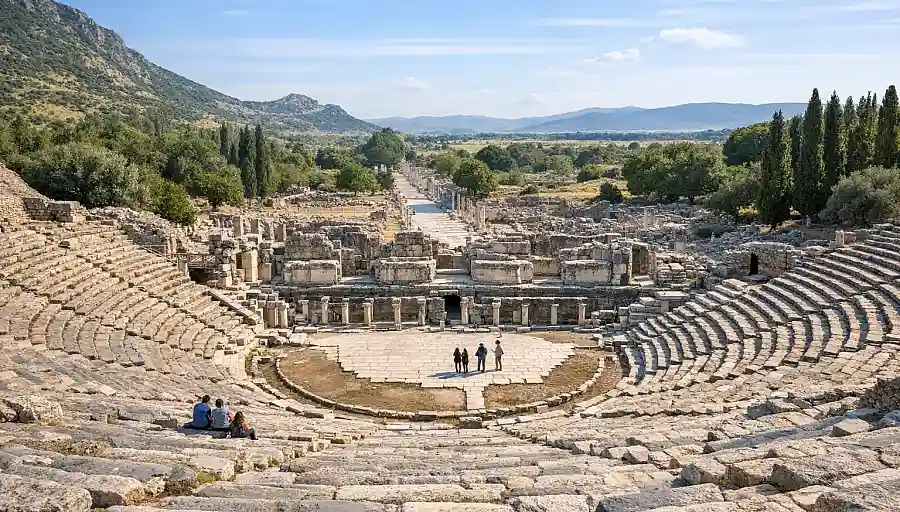
Great Theatre of Ephesus
The Great Theatre of Ephesus is one of the most powerful places on the site, not only because of its scale, but because it helps you imagine the city at its busiest. The theatre was designed for mass gatherings and performances, and its setting connects naturally with the main routes through the city. From the seating area you can appreciate how public life in Ephesus was both communal and carefully staged.
Curetes Street
Curetes Street is one of the key arteries through Ephesus. Walking here is one of the best ways to understand the city’s rhythm: the slope, the paved surfaces, the way monuments appear as you turn, and the sense of movement between important buildings. Look for the small details—inscriptions, fragments, and the way façades were used to shape the experience of walking through a prestigious urban corridor.
Temple of Hadrian
The Temple of Hadrian is a relatively compact monument, but it often becomes a favourite because it sits naturally within the street scene and showcases fine decorative work. It is a good example of how Roman Ephesus used architecture not only for worship, but for visual impact—turning a street into a gallery of status and symbolism.
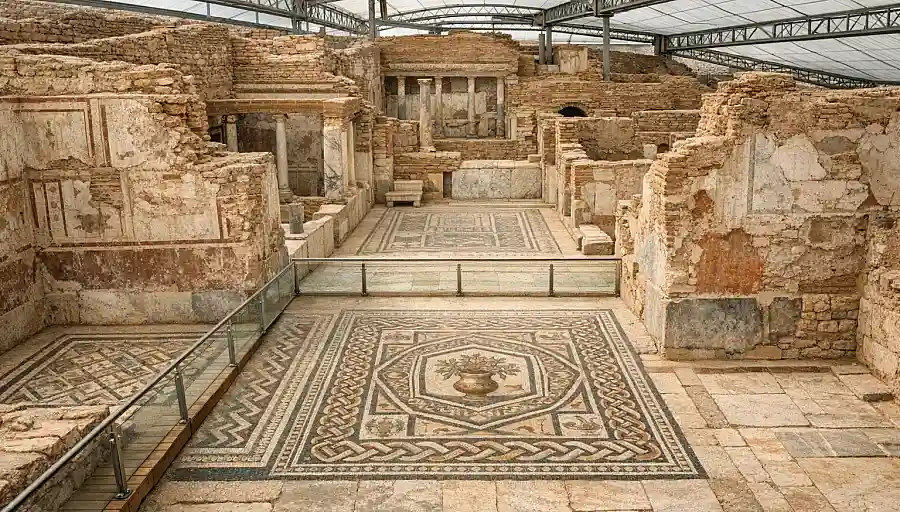
Terrace Houses
If you want to see how wealthy residents lived, the Terrace Houses are the key stop. This area is valued for its interiors, including decorative surfaces and room layouts that reveal domestic comfort and social display. Practical note: access conditions and ticketing can change, and some sections of Ephesus (including the Terrace Houses) may be managed with separate entry arrangements. It is worth checking the latest official information at the site when you arrive.
The wider cityscape: gates, fountains, baths and streets
Even beyond the headline monuments, the real pleasure of the Ephesus ruins is the overall cityscape. You will pass remnants of fountains, bath complexes and public areas that explain what a well-organised Roman city needed: water management, social spaces and routes for both daily movement and ceremonial procession.
Beyond the main site: Temple of Artemis, Selçuk and other key stops
Ephesus is closely tied to several important places nearby, and many travellers combine them into a single day.
Temple of Artemis
The Temple of Artemis is one of the most famous names associated with Ephesus. Although only limited remains are visible today, the site matters because it explains why Ephesus became such an important religious destination. It also helps you see that Ephesus was not only an administrative and commercial city—it was a place of pilgrimage and identity.
Church of the Virgin Mary
The Church of the Virgin Mary is among the most significant Christian landmarks associated with Ephesus. Visiting it adds a Byzantine layer to a day that might otherwise feel purely “classical”. It is a useful reminder that the city’s importance continued as beliefs and political structures changed.
Basilica of St. John and Selçuk town
Selçuk is the natural base for visiting Ephesus. It is also home to major sites in its own right, including the Basilica of St. John. If your schedule allows, pairing Selçuk with Ephesus gives you a broader sense of the region’s long history—ancient, early Christian and later Turkish heritage sitting close together in a compact area.
How to get to Ephesus from Selçuk, İzmir and Kuşadası
Ephesus is straightforward to reach, and your best option depends on where you are staying and how independent you want the day to feel.
- From Selçuk: Selçuk is the closest town. Travellers commonly use a short taxi ride or local transport connections to reach the entrance area, especially if they want flexibility with timing.
- From İzmir: İzmir is the main city in the region. Many visitors travel first to Selçuk, then continue on to Ephesus. If you are staying in İzmir for a city break, an organised day trip can be a comfortable way to manage travel and timing.
- From Kuşadası: Kuşadası is a popular coastal base and a frequent starting point for an Ephesus day trip. Private transport or an arranged tour is often the simplest approach, particularly if you are fitting Ephesus around beach plans or a cruise schedule.
If you prefer a smoother experience—especially in hot weather or when travelling with children or older relatives—consider a private door-to-door plan. TurPolia can arrange a private Ephesus round trip with comfortable hotel pickup and return transfer, helping you focus on the site rather than logistics. You can also contact TurPolia for a private Ephesus tour if you would like a guide and a flexible pace.
Best time to visit, how long to allow, and what to bring
When to go
Ephesus is an open, sun-exposed site, so comfort matters. Many travellers find the shoulder seasons more pleasant for walking. In summer, heat can be a serious factor, so earlier visits and slower pacing can make the day much more enjoyable. If photography is a priority, softer light earlier or later in the day can also suit the pale stone and long streets.
How long you need
A focused visit to the main Ephesus ruins can take a few hours, but it is easy to spend longer if you like reading the site carefully or adding the Terrace Houses. If you also want to include Selçuk town, the Basilica of St. John and the Temple of Artemis, a fuller day is usually more realistic.
What to wear and bring
Comfortable walking preparation makes a noticeable difference at Ephesus. The marble and stone surfaces can be slippery in places, and there are slopes and steps.
- Footwear: supportive shoes with good grip.
- Sun protection: hat, sunscreen and sunglasses are sensible for much of the year.
- Water: carry enough for your walk, especially in warm months.
- Clothing: light layers work well; if you also plan to visit religious sites, modest coverage can be helpful.
Entrance planning and guided-tour advice
Ephesus is popular, and the experience can vary depending on crowds and the time you arrive. If you value context, a guide can turn impressive ruins into a readable city: why this street mattered, what this building was used for, and how Greek, Roman and Byzantine layers fit together.
If you are comparing options, an Ephesus guided tour is particularly useful for travellers who want:
- a clear historical storyline (foundation, growth and later changes), rather than isolated photo stops
- help choosing a sensible walking route and pace
- time-efficient planning when visiting from İzmir or Kuşadası
- an experience tailored for families or older travellers who may need more breaks
If you would like a private schedule rather than a fixed group timetable, TurPolia can help you explore Ephesus with comfortable hotel pickup and return transfer, and can organise a private guide on request. It is a practical way to make room for Selçuk stops such as the Basilica of St. John or to spend extra time at the Terrace Houses without feeling rushed.
A realistic expectation for first-time visitors
Ephesus is sometimes imagined as a single “wow moment”, but the real impact comes from the full walk: the way the city opens up, the changing scale from street to monument, and the contrast between public grandeur and private life. Allow yourself time to pause, look up, and notice details beyond the famous façade of the Library of Celsus.
With a little planning, Ephesus Ancient City can be one of the most memorable historical days in Türkiye—an experience that connects the ancient world to the landscape and towns you see today around Selçuk, İzmir and the Kuşadası coast.
Frequently Asked Questions
Where exactly is Ephesus Ancient City in Turkey?
Ephesus is near the town of Selçuk in the İzmir region of Türkiye, with easy access from both İzmir city and the coastal resort area around Kuşadası.
How long should I allow for an Ephesus day trip?
For the main ruins, allow at least a few hours. If you want a slower pace, the Terrace Houses, and nearby sights in Selçuk such as the Basilica of St. John and the Temple of Artemis, a fuller day is usually more comfortable.
Is it worth taking an Ephesus guided tour?
If you want to understand the foundation story and how Ephesus changed through Greek, Roman and Byzantine periods, a guide can add a lot. A guided tour can also help with pacing and route choice on a busy day.
Is Ephesus suitable for families and older travellers?
Many families and older visitors enjoy Ephesus, but expect uneven stone surfaces, slopes and steps, with limited shade in places. Good footwear, water and a flexible pace help, and private transport can reduce walking between stops.
Do the Terrace Houses need a separate ticket?
Sometimes specific sections, including the Terrace Houses, may have separate entry arrangements. Because ticketing and access rules can change, it is best to check the latest details at the site on the day of your visit.
TurPolia Blog
Travel stories and local tips for discovering Turkey.


