


House of the Virgin Mary in Ephesus: The Story of Its Discovery
 AI-generated illustrative image.
The House of the Virgin Mary near Ephesus is famous not only as a place of pilgrimage, but for the unusual way it entered the modern world’s awareness. Local Christian tradition links the hills above Ephesus with Mary and St John. Centuries later, detailed visions recorded from a German nun, Anne Catherine Emmerich, helped searchers identify a small stone house on the mountain. Today, the Virgin Mary House in Türkiye is visited by travellers of many backgrounds who want to understand the story, see the setting for themselves, and experience a quiet, reflective corner close to one of the country’s most important ancient sites.
What is the House of the Virgin Mary near Ephesus?
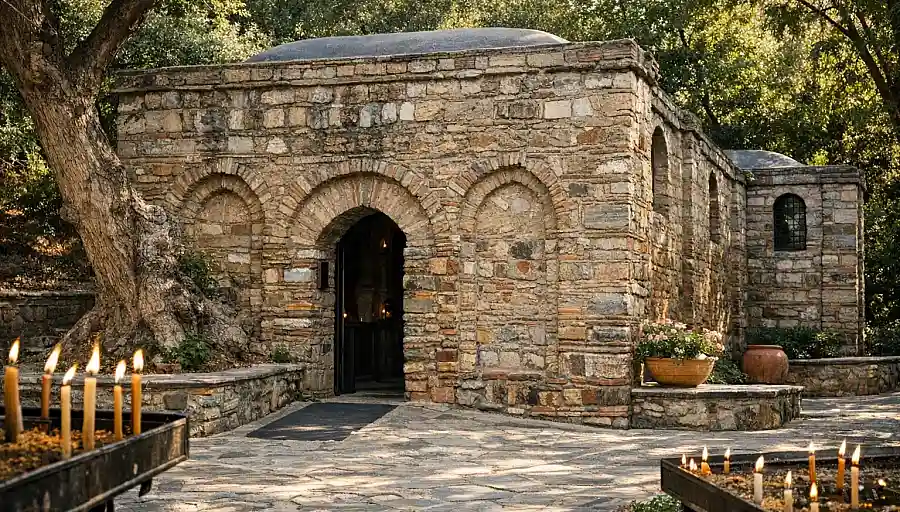
Often referred to as the House of the Virgin Mary Ephesus (and locally as Meryem Ana), the site is a small stone building in the wooded hills near the ancient city of Ephesus, close to today’s town of Selçuk. It functions as a shrine and chapel rather than a museum-like monument: people come to pray, to light candles, and to spend a few quiet minutes away from the crowds that can gather in the ruins of Ephesus.
It is important to understand what the site represents. For believers, it is connected with the final years of Mary’s life. For historians and archaeologists, it is a modest structure with a complex history of use, repair, and interpretation. For many visitors, it sits somewhere in between: a place where a long-held tradition, a remarkable discovery story, and a beautiful natural setting meet.
The tradition: Virgin Mary and St John in Ephesus
The tradition behind the Virgin Mary House is rooted in early Christian memory. In broad terms, it holds that Mary came to the Ephesus area with St John and lived out her later years there, away from the political and religious pressures of larger cities. Ephesus was an important urban centre in the Roman world, and it appears in early Christian texts and traditions, which is one reason the wider region has long carried religious significance for Christians.
This is also where careful wording matters. The idea of Virgin Mary in Türkiye is largely a matter of faith and tradition rather than something that can be proven in the way a date on an inscription can. Visitors often arrive expecting a clear historical verdict. In reality, the story is best approached as a mixture of belief, local memory, and later interest that shaped how the place is understood today.
Anne Catherine Emmerich and the visions that shaped the search
The modern discovery story is closely tied to Anne Catherine Emmerich, a German Catholic nun whose visions were recorded and later published. In these accounts, she described a stone house in a hilly, wooded landscape near an ancient city that matches the Ephesus area. The descriptions were unusually specific, focusing on the setting and the arrangement of the building in a way that encouraged some readers to think the place might still be found.
It is worth separating two different questions that are often blended together:
- Religious question: were the visions spiritually true or meaningful? That is a matter of belief.
- Historical question: did the recorded descriptions correspond to a real, identifiable location in the landscape? That is something people attempted to test by searching.
The House of the Virgin Mary near Ephesus became famous because the second question led to a real-world outcome: visitors and researchers were able to match elements of the description to a plausible site in the hills and identify a small building that local people already knew in various ways.
 AI-generated illustrative image.
How the house was located using the vision descriptions
The story is often retold as a kind of historical detective tale. Inspired by Emmerich’s descriptions, searchers explored the countryside above Ephesus, looking for a place that fit the details: the mountainous setting, the sense of seclusion, and the presence of a small stone structure rather than a grand church. When a candidate site was identified, attention gradually focused on the building and its surroundings.
It is easy to assume this was a single dramatic moment of discovery. In practice, sites like this usually become established through a series of steps: local knowledge, outside interest, repeated visits, and later evaluation. The power of this particular story lies in how a spiritual text influenced real travel and investigation, eventually shaping a place that is now on many visitors’ Ephesus itineraries.
History and archaeology: what can be said with care
Travellers often ask whether the building standing today is “the original house”. That question is more complicated than it sounds. The structure visible now reflects restoration and maintenance over time, and the site’s long history has been interpreted through both religious devotion and practical conservation.
What can be said more safely is this: the place has been treated as significant for a long time, and the physical structure shows signs of being part of a longer story rather than a modern invention. Archaeological work and historical study have been used to assess the building and the setting, but archaeology cannot, by itself, prove that a particular individual lived in a particular room two thousand years ago. That gap between material evidence and personal identity is exactly where tradition and faith play a role.
If you visit, you will notice how modest the building is. That simplicity is part of the site’s appeal for many people. It feels less like a “monument” and more like a place kept for reflection, which suits the way the story is told.
Why the Virgin Mary House matters to Christianity (and beyond)
For many Christians, the House of the Virgin Mary Ephesus represents a deeply personal connection to Mary and to the early period of the Church in Anatolia. It is also significant because it sits close to Ephesus, a name that carries weight in Christian history and memory.
At the same time, visitors in Türkiye often notice something else: Mary is also honoured in Islam as Maryam. While religious practices and interpretations differ, the respect shown to Mary helps explain why the site can feel welcoming to a wide range of visitors. People come with different beliefs, and many simply come with curiosity and respect.
 AI-generated illustrative image.
Papal visits and international attention
Another reason the site became widely known is the international attention it has received in the modern era. High-profile Christian leaders have visited the shrine, and papal visits are frequently cited as a sign of its importance within Catholic devotion. This kind of attention tends to shape how a place is perceived: it moves from being a local tradition to a destination recognised by travellers around the world.
Because specific details around official visits can be reported differently in different sources, it is best to treat the broader point as the takeaway: the shrine is not only a local curiosity. It is part of a wider map of pilgrimage that links Ephesus to Christian travel routes well beyond Türkiye.
What it is like to visit today
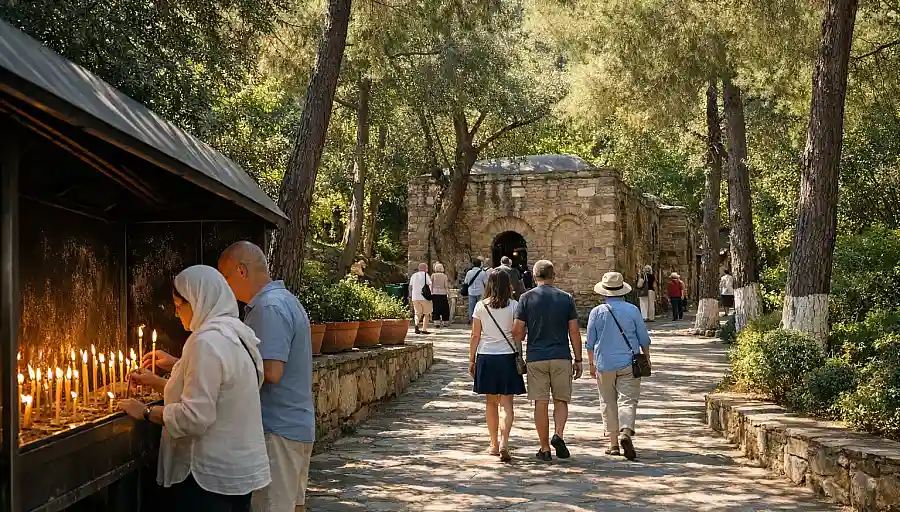
Most visits to the Virgin Mary House are calm and unhurried. The setting is green and quiet, with a sense of distance from the main archaeological zone of Ephesus. Inside and around the chapel, you may see people praying, lighting candles, or leaving written intentions in the customary way for this kind of shrine.
A few practical expectations can help you plan:
- It is not a large complex. The focus is the small chapel-house and the immediate grounds.
- It is a place of worship. Even if you are visiting as a tourist, it is worth keeping your voice low and dressing respectfully.
- It pairs naturally with Ephesus. Many travellers visit on the same day as the ancient city and nearby historic sites around Selçuk.
Common misunderstandings to avoid
A few misconceptions come up again and again when people research the House of the Virgin Mary in Türkiye:
- “It’s inside the ruins of Ephesus.” It is near Ephesus, but it is a separate site in the hills, with its own atmosphere.
- “Archaeology proves Mary lived there.” Archaeology can help date and understand a structure, but it cannot confirm personal identity in the way many people hope.
- “It will feel like a big cathedral.” The building is small, and the experience is more about place and tradition than grand architecture.
- “The discovery was purely religious or purely scientific.” The story sits between the two: spiritual visions inspired a search, and the site then developed through investigation, preservation, and devotion.
A thoughtful way to approach the story
If you are interested in the discovery story, it helps to hold two ideas at once. First, the tradition is meaningful to many people and has helped shape real places in the landscape around Ephesus. Second, historical certainty is limited, and different visitors will weigh the evidence and the tradition differently.
Taken on its own terms, the House of the Virgin Mary near Ephesus is worth visiting for what it is today: a serene hilltop shrine with a remarkable modern discovery story, closely tied to one of Türkiye’s most compelling historic regions.
Frequently Asked Questions
Is the House of the Virgin Mary actually in the ancient city of Ephesus?
No. It is near Ephesus, in the hills outside the main archaeological site. Many travellers visit both on the same day, but they are separate locations.
How is Anne Catherine Emmerich connected to the Virgin Mary House?
Her recorded visions described a small stone house in a hilly landscape near an ancient city identified with Ephesus. Those descriptions inspired later searchers to look for a matching site in the area.
Is there proof that Mary lived there?
There is no definitive historical proof that can confirm Mary lived in that specific building. The site is important because of long-standing tradition, religious devotion, and the way it was identified and preserved in modern times.
Do you have to be Christian to visit the House of the Virgin Mary in Türkiye?
No. Visitors of any background can usually enter as long as they respect that it is a place of worship, keep noise low, and dress appropriately.
How long should I allow for a visit?
The shrine itself is relatively small, so many people spend a short, reflective visit on site. Total time depends mainly on transport and how you combine it with Ephesus and nearby stops.
TurPolia Blog
Travel stories and local tips for discovering Türkiye.


