


Public Transport or Organised Tours: How to Explore Türkiye

Choosing between public transport and organised tours in Türkiye isn’t about finding a single “right” answer. It’s about matching the travel style to your route, time and confidence with planning. Public transport can be a strong choice for city breaks and flexible itineraries, while organised tours often make complex sightseeing days smoother, especially when you want clear timing and a licensed guide. Many travellers end up using a mix of both.
Start with your route: some parts of Türkiye are simple, others take effort
Türkiye is a large country, and the travel experience changes a lot depending on where you’re going. Big cities and popular resort areas usually have plenty of transport options and tourist-ready services. Rural areas, smaller towns and some national-park-style landscapes can be more time-consuming to reach, with fewer connections and less English spoken day-to-day.
Before deciding, sketch your trip in two layers: (1) how you’ll move between regions, and (2) how you’ll get from your accommodation to the places you actually want to see. The second part is where people often underestimate the effort.
Public transport in Türkiye: what’s available and what it’s like to use
Independent travel is very doable in Türkiye, but it rewards travellers who are comfortable checking timetables, confirming pick-up points and adjusting plans when things don’t line up perfectly. The main tools are long-distance coaches, local minibuses (dolmuş), city metros and trams where available, plus domestic flights for longer jumps.
Intercity coaches (long-distance buses): good coverage, but plan the “last mile”
Long-distance coaches are widely used for travelling between cities and larger towns. They can be comfortable and frequent on popular routes, and they’re often a practical alternative to driving if you’d rather not handle roads and parking.
The main drawback is what happens at each end. Bus terminals can be outside the centre, and you may need an extra step (taxi, local bus, metro or a dolmuş) to reach your hotel and the sights. If you’re travelling with luggage, arriving late, or trying to connect onwards the same day, this “last mile” can be the stressful part.
Dolmuş (shared minibuses): very local, very useful, sometimes confusing
Dolmuş shared minibuses can be brilliant for short trips within towns and between nearby areas, including places where larger buses are limited. They’re part of everyday life and often the quickest way to cover small distances.
They can also be the hardest for first-time visitors to read. Routes may be shown on the vehicle in Turkish, stops can be informal, and it’s not always obvious where to get off. If you’re happy asking simple questions, using map apps and staying flexible, dolmuş travel can feel easy. If you’d prefer clear signage and fixed stops, you may find it tiring on a tight sightseeing day.
Metro and tram systems: excellent where they exist
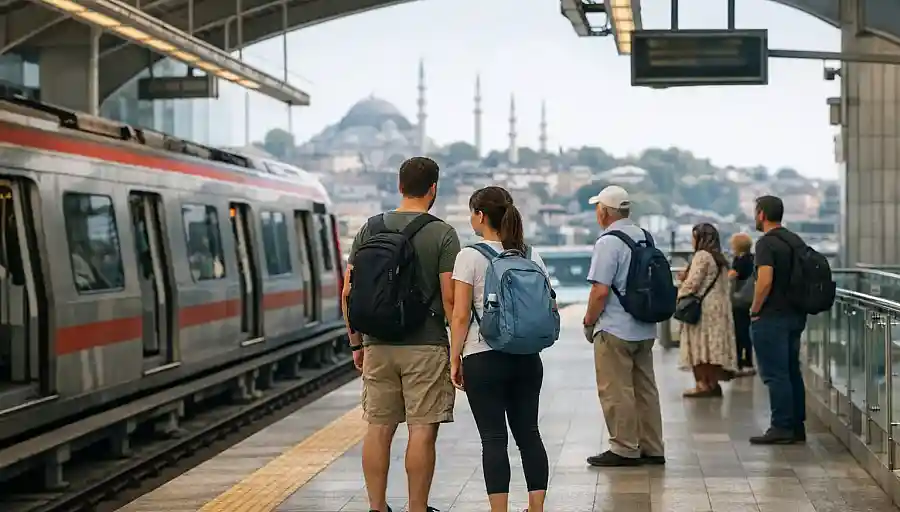
In larger cities, metro and tram networks can be one of the easiest ways to move around, especially for popular districts where traffic makes road travel slow. This is where independent travel often feels most straightforward: clear stations, regular services, and less need to negotiate.
The limitation is coverage. Once you leave the urban core, you may still need buses, taxis or walking for the final stretch, and some attractions sit well outside any rail network.
Domestic flights: a time-saver when distances are big
For travellers covering multiple regions, domestic flights can reduce long travel days. They’re particularly useful when your holiday is short and you want to combine distant areas without spending too much time on the road.
The trade-off is that flying adds extra steps: getting to the airport, security screening, baggage rules, and then ground transport at the other end. Schedules and costs can also vary by season and demand, so it’s worth comparing the “door-to-door” effort rather than just the flight time.
Taxis: convenient for short hops, but check the basics
Taxis are useful when you’re carrying bags, travelling at awkward hours, or bridging a gap that public transport doesn’t cover well. In tourist areas, you’ll often have plenty available.
To reduce misunderstandings, it helps to confirm the destination clearly (showing it on your phone can be easier than pronouncing it), and pay attention to the route and the meter practices in that city. Traffic can also change the experience completely, so build in time if you’re heading to a museum entry slot, a boat departure or a flight.
Car rental: maximum freedom, extra responsibility
Hiring a car can make sense if you want to reach countryside viewpoints, small villages or trailheads, or if you’re travelling as a group and prefer door-to-door convenience. It also gives you freedom to stop whenever you want, which is hard to replicate on a fixed tour timetable.
On the other hand, driving brings its own workload: navigation, parking, fatigue on long days, and understanding local road habits. Cities can be particularly demanding for parking and traffic. If you’re mainly visiting city landmarks and major museums, car hire may add hassle rather than remove it.
Public transport: when it tends to work best
- City-based trips where you can walk a lot and use metro/tram lines.
- Flexible itineraries where you don’t mind adjusting plans if a connection isn’t ideal.
- Budget-focused travel where you’re happy trading some convenience for lower day-to-day costs.
- Slow travel where the journey is part of the experience and you’re not trying to “do everything”.
Public transport: common frustrations for tourists
- Time management on multi-stop sightseeing days (waiting, transferring, finding platforms and stops).
- Language barriers outside the most tourist-centred areas, especially with dolmuş routes and smaller stations.
- Complex logistics for remote historical sites, national parks and viewpoints.
- Energy cost: planning and problem-solving can be fun, but it can also wear you down on a short holiday.
Organised tours: what they solve, and what you give up
Organised tours in Türkiye range from small-group day trips to multi-day routes covering several regions. The main value is not only transport: it’s the planning, pacing and context. A good tour removes dozens of small decisions from your day.
Day tours: ideal for “hard to stitch together” sightseeing
Day tours are often at their strongest when the sightseeing sits outside the city, involves multiple stops, or would otherwise require a chain of taxis and local buses. You’re paying for a coherent plan: pick-up, transport, visit sequence, and enough time at each place to make the day feel worthwhile.
If your priority is seeing key highlights efficiently (rather than maximising independence), a day tour can be the difference between a smooth day and a day spent mostly on logistics.
Multi-day tours: a structured way to cover long distances
Multi-day tours tend to suit travellers who want to see several regions in one trip without continuously researching connections, booking transport and working out realistic timings. They can also reduce the mental load of changing hotels, keeping track of local transport options, and estimating how long a site truly needs.
The compromise is flexibility. You’ll follow a set route and a group pace. If you love spontaneous detours, slow mornings or unplanned museum time, you may prefer to travel independently and add a few guided days instead of committing to a full multi-day programme.
Why licensed guides and licensed operators matter
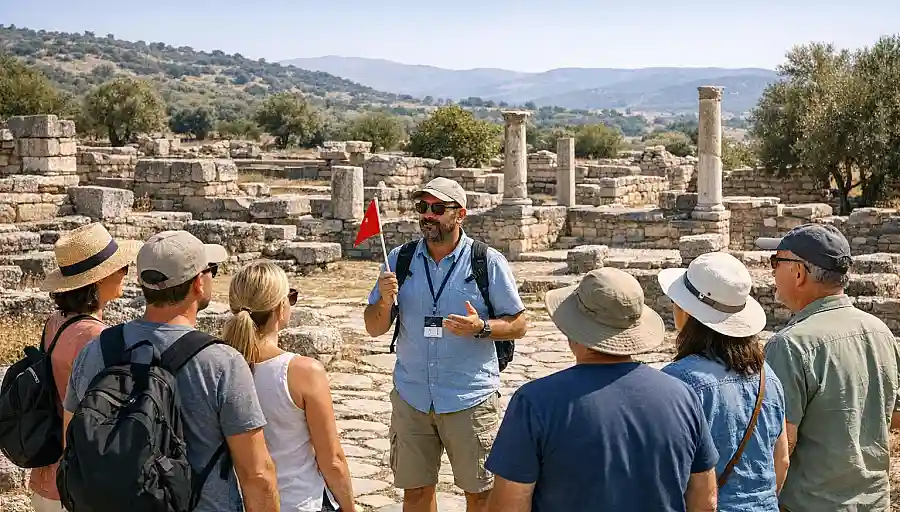
When you choose an officially organised tour in Türkiye, the goal is to get a professional service: clear responsibilities, qualified guiding, and a properly planned itinerary. Licensed professional tourist guides can add real value at historical sites and museums, not just through facts but through context that helps you understand what you’re seeing.
It also helps you avoid common travel pitfalls: unofficial operators with vague plans, unclear meeting points, or “surprise” stops that eat into your day. Organised tours sold by licensed operators are typically arranged with the necessary permissions and insurance provisions for their services, but it’s still wise to check what is included when you book, as details can vary.
If you’d like to compare guided options as part of your planning, you can explore TurPolia’s organised tours in Türkiye and use the itineraries as a reference point for what’s realistically doable in a day.
Organised tours: when they tend to be the better fit
- First-time visitors who want to see major sites with minimal uncertainty.
- Short holidays where time matters more than total freedom.
- History-heavy trips where a licensed guide’s explanation changes the experience.
- Families and multi-generation groups who benefit from smooth logistics and fewer transfers.
- Remote stops that are awkward by public transport (multiple connections, sparse services).
Organised tours: where they can disappoint
- Less independence: you can’t linger wherever you like.
- Group pace: the day moves at the speed of the group, not your personal rhythm.
- Style mismatch: some travellers prefer exploring quietly without structured commentary.
- Quality varies: choosing reputable, licensed providers matters.
Which option suits different travellers?
Families and elderly travellers
For families (especially with younger children) and older travellers, comfort and predictability often matter more than perfect flexibility. Organised day tours can reduce walking between connections, remove the pressure of finding the right bus stop, and keep the day’s timing realistic. Private or small-group formats can also feel calmer if large groups sound tiring.
Public transport still works well in cities, particularly if your accommodation is central and you can build in breaks. The key is not trying to do too much in one day.
Solo travellers
Confident solo travellers often enjoy public transport because it’s cost-effective and encourages local interaction. It can be a rewarding way to travel between cities and explore neighbourhoods at your own pace.
Organised tours can still be useful solo, especially for day trips to places that are awkward alone or for travellers who want a guided, social day without the commitment of a multi-day group tour.
Budget travellers
Public transport usually gives the most control over spending, particularly if you’re happy choosing simpler routes and travelling a bit slower. The cost you don’t see on paper is time: if a complicated day requires multiple taxis or a missed connection forces an extra night somewhere, the “cheap” plan may stop feeling cheap.
A selective approach often works best: use public transport for straightforward city-to-city moves, and pay for an organised day tour when it replaces a complicated chain of transport steps.
First-time visitors to Türkiye
If it’s your first visit, it’s normal to underestimate how much energy planning can take in a new country, especially if you’re also adjusting to jet lag, heat, crowds, or unfamiliar neighbourhood layouts. Organised tours can create a comfortable foundation: you learn the rhythm of the country, then use public transport more confidently later in the trip.
Nature, national parks and outdoor landscapes
For outdoor areas, the biggest question is access. Some landscapes are easy to reach, while others are impractical without a car or a tour vehicle. If you’re not driving, an organised tour can be the simplest way to get to trailheads, viewpoints and park-style areas and still return without worrying about the last bus back.
A practical hybrid approach that works well in Türkiye
Many travellers get the best experience by combining methods rather than choosing only one. A common, low-stress pattern is:
- Use metro/trams and walking for city days and museums.
- Use intercity coaches or domestic flights for big regional moves.
- Add organised day tours for remote highlights, multi-stop days, or places where guiding adds real value.
This approach keeps your trip flexible, but protects your limited holiday time on the days where transport connections and timing matter most. If you want a simple way to compare what’s feasible, you can look through TurPolia’s guided sightseeing options and then decide which days you’d prefer to do independently.
A simple decision checklist
If you’re stuck between public transport and organised tours, these questions usually make the choice clearer:
- Is the place easy to reach on one direct route? If not, a tour may save a lot of time.
- Do you need a clear plan for one specific day? Tours suit days with multiple stops or fixed timing.
- How important is historical explanation? For major heritage sites, a licensed guide can change what you take away.
- Are you comfortable problem-solving in a new language environment? If not, lean towards organised services for the trickier days.
- Do you enjoy planning? Some travellers genuinely love it; others would rather spend that energy on the destination itself.
Finally, remember that costs and schedules vary by destination, season and demand. It’s worth checking current options for your exact dates, then choosing the mix that gives you the holiday you actually want: relaxed, independent, efficient, or a bit of everything.
Conclusion: pick the style that matches your trip, not someone else’s
Public transport is a strong way to explore Türkiye when your route is simple, you have time to be flexible, and you enjoy travelling independently. Organised tours come into their own when you want reliable time management, comfortable transport, and professional guidance at historical sites or on complex day trips. If you plan a hybrid trip, you can keep your freedom while still getting expert help on the days where it makes the biggest difference.
Frequently Asked Questions
Is public transport in Türkiye easy if I don’t speak Turkish?
It can be, especially in larger cities and major tourist areas. For intercity buses and rail-based city transport, you can usually manage with apps, maps and basic phrases. Dolmuş routes and smaller towns may require more asking around, so build in extra time and stay flexible.
Are organised tours in Türkiye worth it for historical sites and museums?
They can be, particularly when a licensed professional guide is included. Good guiding adds context and helps you understand what you’re seeing, which can be hard to get from signage alone. If you prefer exploring quietly, you might choose a shorter guided visit rather than a full-day tour.
Should I rent a car to travel around Türkiye?
A car can be useful for countryside routes, remote viewpoints and places with limited public transport. It can be less enjoyable in busy cities due to traffic, parking and general driving effort. Consider where you’ll actually drive and whether you want the responsibility on holiday.
How do I avoid unofficial or poor-quality tours?
Look for tours run by officially licensed operators and guided by licensed professional tourist guides. Confirm what is included before you pay (transport, guiding, tickets, and any insurance arrangements) and be cautious of vague itineraries or unclear meeting details.
Can I combine public transport with organised day tours?
Yes, and it’s often a very practical approach. Many travellers use public transport for city days and long-distance moves, then book organised day tours for remote highlights or multi-stop sightseeing days where planning and timing are harder to manage independently.
Tales Beyond Borders


