


Seven Churches Tour in Turkey: A Biblical Journey Through Ancient Asia Minor

A Seven Churches Tour in Turkey is a route through western Türkiye that follows the locations traditionally linked to the seven churches addressed in the Book of Revelation. For many travellers, it is both a biblical pilgrimage and a fascinating journey through the remains of ancient cities. The experience is mainly archaeological: you should expect ruins, foundations, columns and ancient streets rather than fully preserved church buildings. Because the sites are spread across a wide area, most visitors either join a guided round trip or plan a multi-stop itinerary with several overnight bases.
Why the “Seven Churches” matter for travellers
In Revelation, seven messages are addressed to seven early Christian communities in “Asia” (in a Roman provincial sense, not the continent as a whole). Those communities are widely associated with cities in today’s western Türkiye. Visiting the region helps put the text into a real landscape of ports, trade routes, valleys and hilltop citadels. Even if you are not travelling for religious reasons, the route connects some of the most significant ancient sites in the Aegean and inland Anatolia.
Many people find the journey especially meaningful because it is not focused on one single place. It is a story told over several stops: coastal cities, fertile plains, and inland towns where the ancient world still sits just under the surface.
Where are the Seven Churches in modern Türkiye?
The seven churches are commonly identified with sites in and around these modern locations in western Türkiye:
- Ephesus (near Selçuk)
- Smyrna (modern İzmir)
- Pergamum (near Bergama)
- Thyatira (often linked with Akhisar)
- Sardis (near Salihli)
- Philadelphia (often linked with Alaşehir)
- Laodicea (near Denizli, not far from Pamukkale)
You will sometimes see slightly different wording or emphasis depending on the itinerary style and the archaeological remains available at each stop. In several places, the visit is about understanding the ancient city and its setting, even when visible Christian-era structures are limited.
What you can realistically expect to see on the route
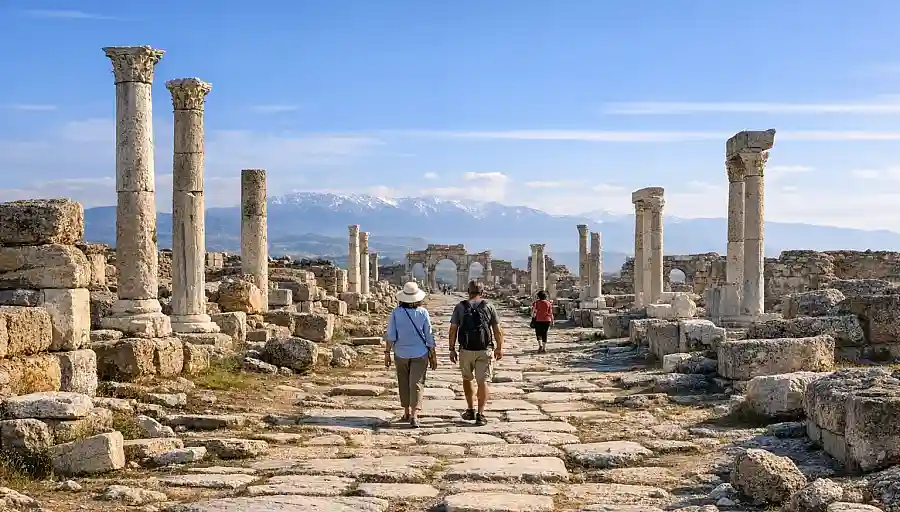
One of the biggest surprises for first-time visitors is that the “churches” are not a set of seven similar-looking religious buildings. The tour is a blend of:
- Major Greco-Roman ruins (such as marble streets, theatres, agoras and temples) that help you understand the city each community lived in.
- Later-period remains (where present) such as basilica foundations, inscriptions or structural traces linked to early Christian history.
- Modern urban context, especially in İzmir, where the ancient and modern city overlap.
The pace is usually steady rather than rushed, but it does involve frequent road travel and a fair amount of walking on uneven stone surfaces. If your goal is reflection and reading, it helps to allow time at each stop rather than trying to “tick off” all seven in the shortest possible schedule.

How a Seven Churches itinerary usually flows
Most Seven Churches itineraries run as a west-to-east (or east-to-west) loop across the Aegean region and inland valleys. The order can vary, but many routes naturally combine:
- The İzmir area for Smyrna and as a practical transport hub
- The Selçuk area for Ephesus and nearby heritage sites
- The Bergama area for Pergamum
- Inland stops for Thyatira, Sardis and Philadelphia
- The Denizli area for Laodicea, often paired with Pamukkale
Because the route spans multiple towns and provinces, a guided round trip can simplify logistics such as transport, pacing and how the sites connect historically. If you prefer to explore independently, it is still very doable, but it rewards careful planning around driving time, parking, and the fact that several locations are better understood with background context.
A quick look at the seven stops (and what makes each distinctive)
Ephesus
Ephesus is often a highlight because it is one of the most extensive and visually impressive ancient cities in the region. As a visit, it helps you grasp the scale and sophistication of urban life in Roman Asia Minor. For biblical travellers, it is also strongly associated with the early Christian world and the wider story of the New Testament era.
Smyrna (İzmir)
Smyrna is linked with modern İzmir, a living coastal city. This part of the journey can feel different because you are not walking through a single, self-contained archaeological park in the same way. It is often more about locating the historic setting and understanding continuity and change over time.
Pergamum (Bergama)
Pergamum is known for its dramatic hilltop setting and powerful sense of place. The landscape alone helps explain why this was an influential city. Even travellers with a purely historical interest tend to find this stop memorable because of the elevated views and monumental scale.
Thyatira (Akhisar area)
Thyatira is commonly associated with today’s Akhisar area. Compared with the bigger headline sites, the visit can be more understated, and it benefits from good interpretation. Many visitors appreciate it as part of the wider narrative rather than as a standalone “big ruins” day.
Sardis
Sardis is usually valued for its archaeological atmosphere and its setting in a fertile valley. It can feel like a bridge between coastal Aegean culture and the inland routes of Anatolia, which is part of what makes the Seven Churches journey feel like a genuine overland trail rather than a single destination.
Philadelphia (Alaşehir area)
Philadelphia is traditionally linked with the Alaşehir area. As with Thyatira, the physical remains may be less immediately dramatic than Ephesus or Pergamum, but it completes the geographical and spiritual arc of the seven messages and brings you deeper into inland western Türkiye.
Laodicea (Denizli area)
Laodicea is commonly visited in the Denizli region, often alongside Pamukkale for travellers combining biblical heritage with natural scenery. It is an area where the scale of ancient urban planning can come through clearly, and it also works well logistically as a base for the eastern end of many Seven Churches routes.
Planning tips for a smoother Seven Churches trip
Allow enough time. While it is tempting to compress the route, the journey is more rewarding when you have time to walk slowly, pause for viewpoints, and absorb the setting of each ancient city.
Wear the right footwear. Expect uneven stone paving, steps and rubble paths. Comfortable walking shoes with grip make a noticeable difference.
Bring sun and water essentials. Western Türkiye can feel very sunny at open archaeological sites, with limited shade in some areas. A hat, sunscreen and a refillable water bottle are practical basics.
Read a little before you go. Even a short read-through of Revelation chapters 2–3 (in your preferred translation) helps you connect the names to the themes, without turning your day into a study session.
Decide how much context you want on-site. Some travellers are happy with a guidebook and signage; others prefer a licensed guide who can tie together biblical references, Roman-era history and what is visible on the ground.
Common misunderstandings to avoid
- Expecting intact churches. The “Seven Churches” are early communities; what survives today is often the broader ancient city setting, plus later-period traces where available.
- Assuming everything is in one place. The route is spread across western Türkiye, and travel time is part of the experience.
- Thinking the stops are all equally large. A few sites are major archaeological parks, while others are smaller and more interpretive in nature.
- Relying on a single online map pin. Some locations are best understood as a wider area rather than one monument.
Joining a guided Seven Churches tour vs travelling independently
There is no single “right” approach, but it helps to choose based on what you value most:
- Guided round trip: typically easier for transport, sequencing, and historical/biblical explanation across multiple days.
- Independent travel: offers maximum flexibility, but you will want to plan driving routes, parking and timing carefully, and you may need to do more background reading to get the same depth of context.
If you are looking for a structured multi-stop itinerary in Türkiye, you can browse TurPolia’s round trips in Turkey and see which routes fit your preferred pace and starting point.
A meaningful journey, even if you are not travelling purely for faith
The Seven Churches route works on several levels: as a biblical journey, as a deep dive into the ancient cities of Roman Asia Minor, and as an overland travel experience through the Aegean and inland landscapes of Türkiye. With realistic expectations and a sensible itinerary, it can be one of the most rewarding heritage routes in the country.
Frequently Asked Questions
Are the Seven Churches of Revelation really in Turkey?
They are traditionally associated with locations in western Türkiye, in the region known in Roman times as Asia (Asia Minor). Modern place names and exact identification can vary slightly by source, so it helps to treat the route as a historical-biblical itinerary rather than a single fixed set of buildings.
How long do you need for a Seven Churches tour?
Most travellers find it works best as a multi-day trip because the sites are spread across different towns and inland valleys. The right length depends on how much time you want at each archaeological site and whether you are combining the route with places like Pamukkale or the Aegean coast.
Do you need a guide for the Seven Churches route?
Yes, a licensed professional tour guide is essential for the Seven Churches route. An official guide provides accurate and detailed information about the Book of Revelation, Roman-era history, early Christianity and the archaeological remains visible at each site. Furthermore, organised group tours in Türkiye are legally required to be accompanied by an officially licensed, certified tour guide.
Will I see actual churches at each of the seven locations?
Not necessarily. In many places, the most visible remains are from the wider ancient city (streets, theatres, agoras and public buildings). Some locations have later-period Christian-era traces, but the experience is generally archaeological rather than visiting preserved church buildings.
Is the Seven Churches tour suitable for travellers with limited mobility?
Some sites involve uneven stone paths, steps and longer walks in open areas. Suitability varies by location and by the exact route, so it is worth discussing mobility needs in advance and planning a pace with plenty of breaks.
TurPolia Blog
Travel stories and local tips for discovering Turkey.


